Category:
Web Design, Client Project
Role:
Data Vizulization, UX/UI
Our Approach
Challenged to reimagine PIH Canada’s online donor experience, our team set out to make giving more personal, transparent, and emotionally meaningful. From the beginning, our approach centred on understanding why younger donors hesitate to give and how design could rebuild trust. We conducted extensive background research, gathered survey data from 78 participants, and interviewed donors across multiple demographics to understand motivations, barriers, and expectations. This foundation shaped every step of our ideation, mapping, and prototyping process.
Vision and Innovation
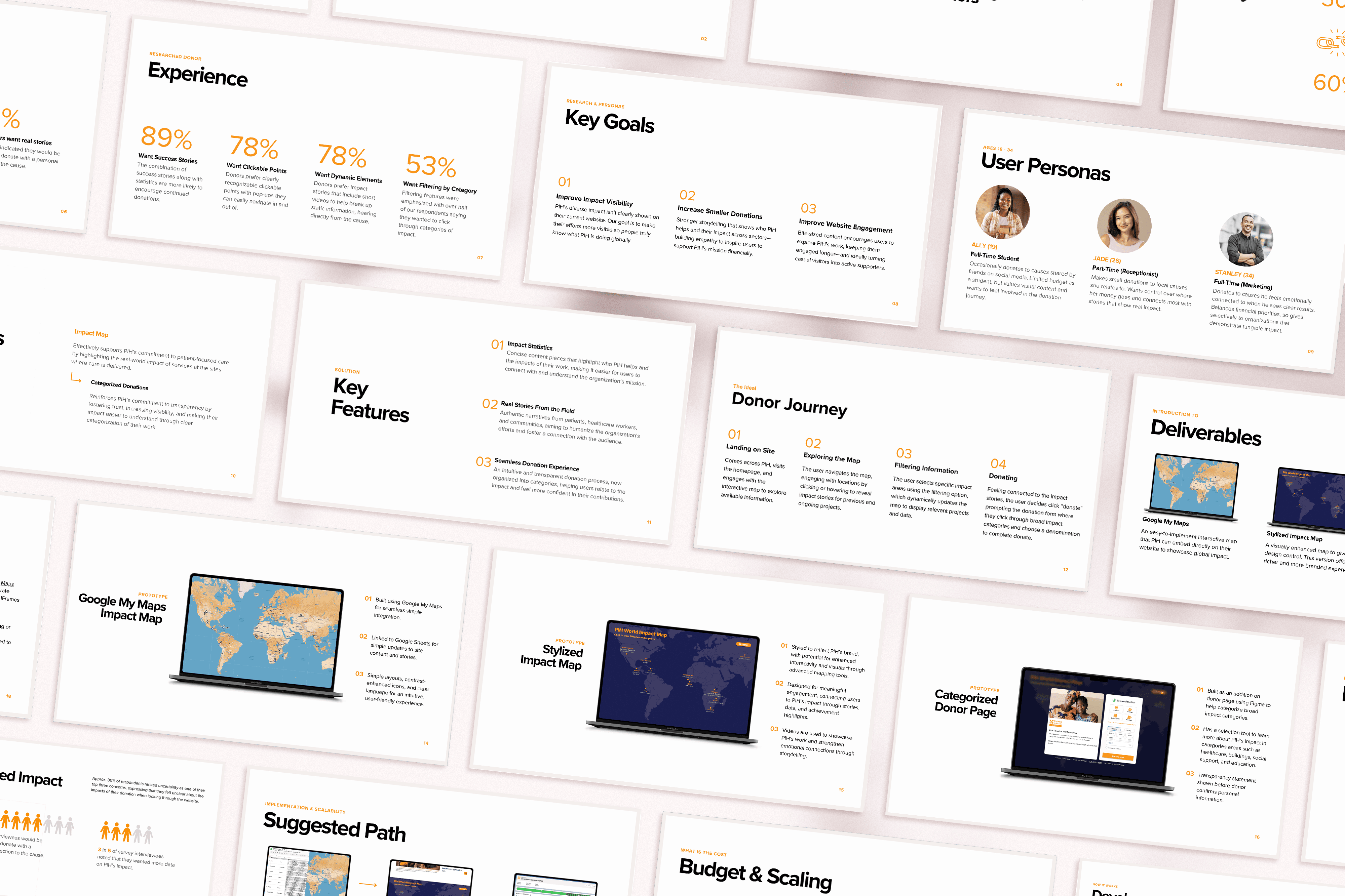
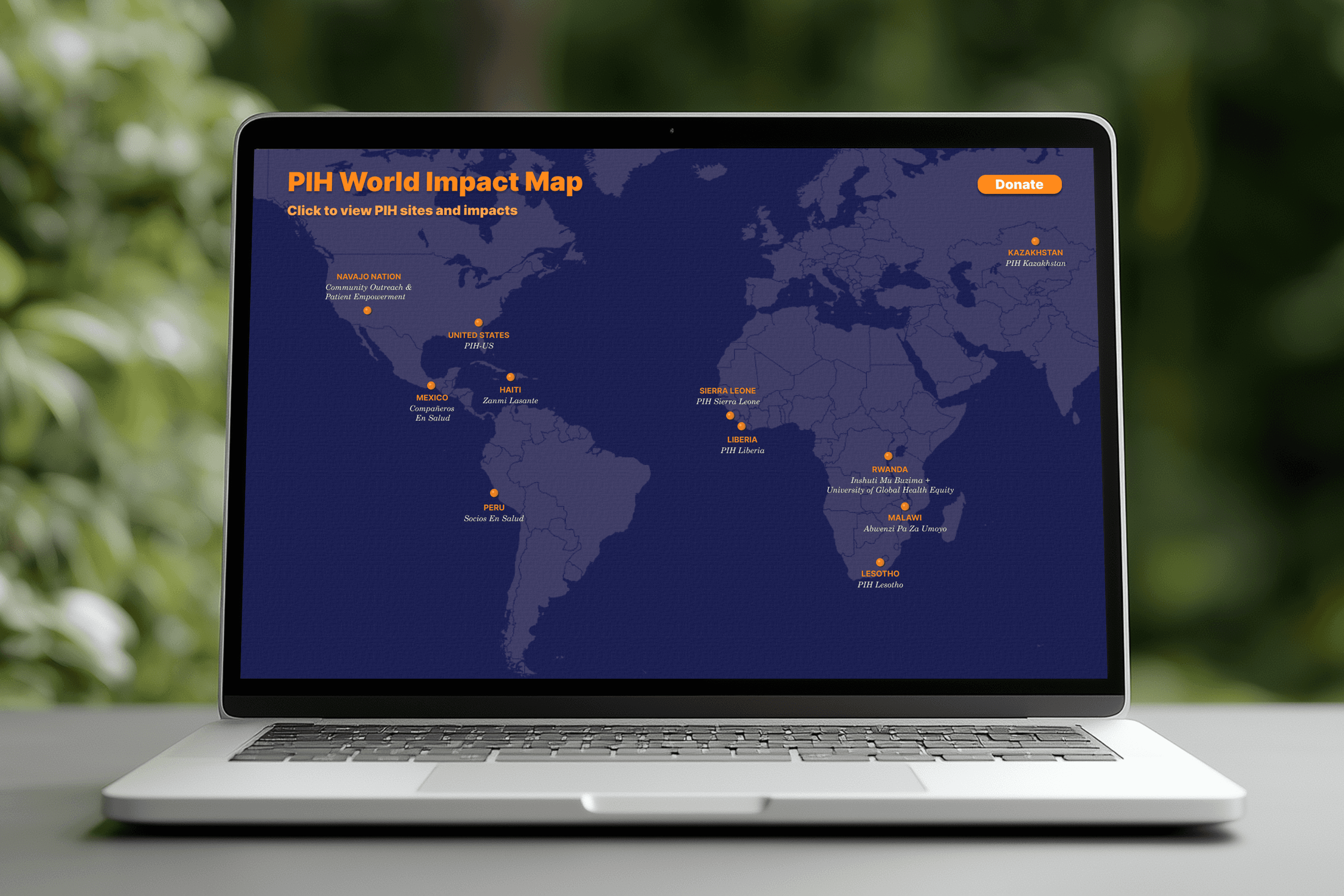
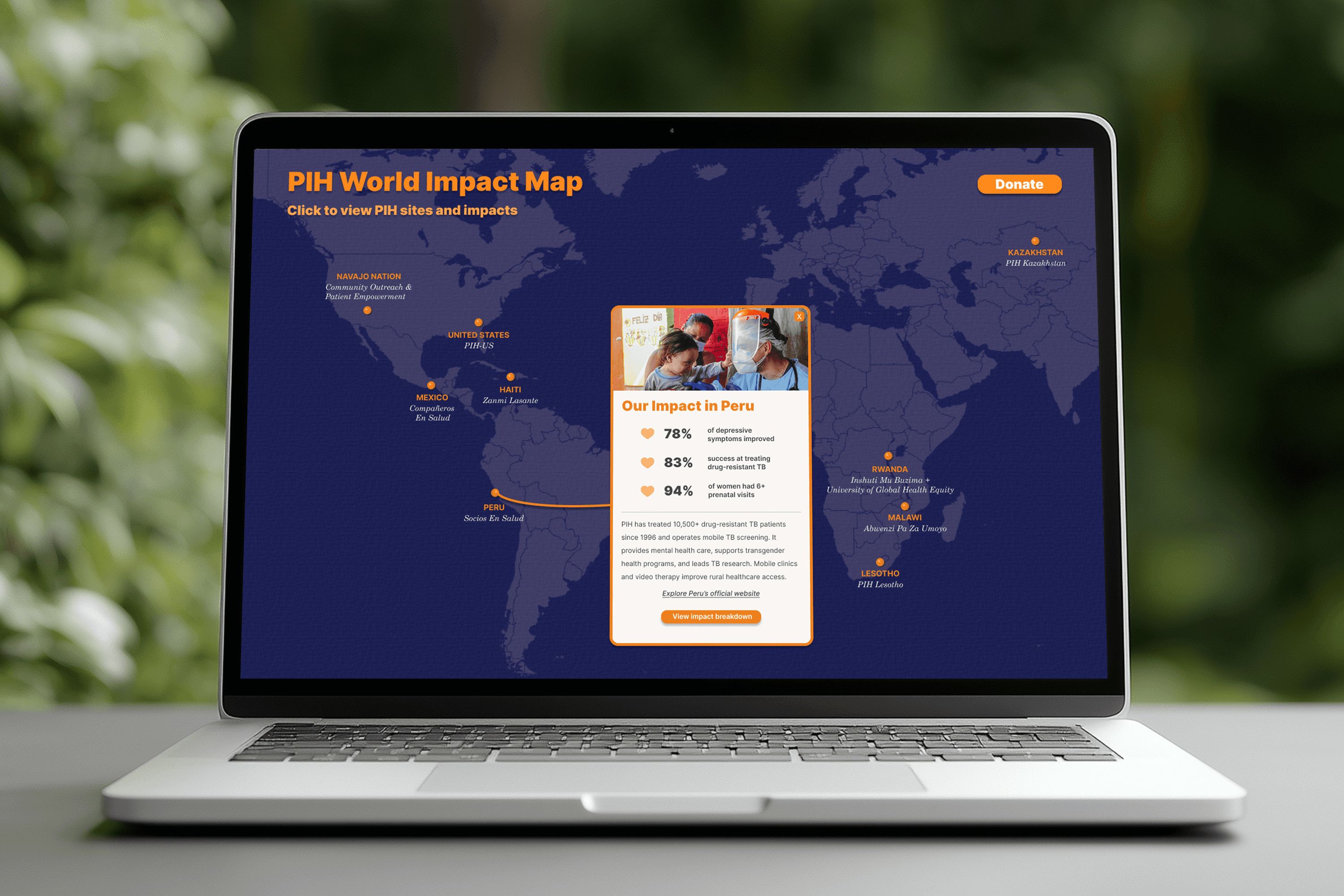
Our vision was to design an interactive platform that highlights the real-world impact of smaller, recurring donations. This meant transforming abstract global health data into an experience that feels human, navigable, and grounded in storytelling. By blending clickable maps, categorized donation pathways, and narrative elements, our prototype aimed to build empathy, trust, and long-term engagement with PIH’s mission.
Proudly, our concept ultimately inspired PIH Canada to introduce an interactive impact map on their official website — a real-world testament to the strength of our approach.
Identifying Unique Challenges
Research uncovered several core challenges:
Low awareness and trust: 92% of surveyed respondents were unaware of PIH Canada, and many expressed uncertainty about how donations are used.
Lack of transparency: Many younger donors struggle to understand global impact through static content and long reports.
Navigation difficulties on the current site: Interviewees frequently noted confusion, difficulty locating impact information, and a desire for clearer visual breakdowns.
Barriers to recurring giving: Financial constraints and limited visibility into donation impact discouraged younger donors from committing monthly.
These insights highlighted a clear need for an interactive, visual, and data-driven experience.
Resolving Complex Problems
We resolved these challenges through layered design solutions that improved clarity, transparency, and engagement:
Simplifying impact discovery through a map-based interface that allows donors to explore PIH’s global work visually.
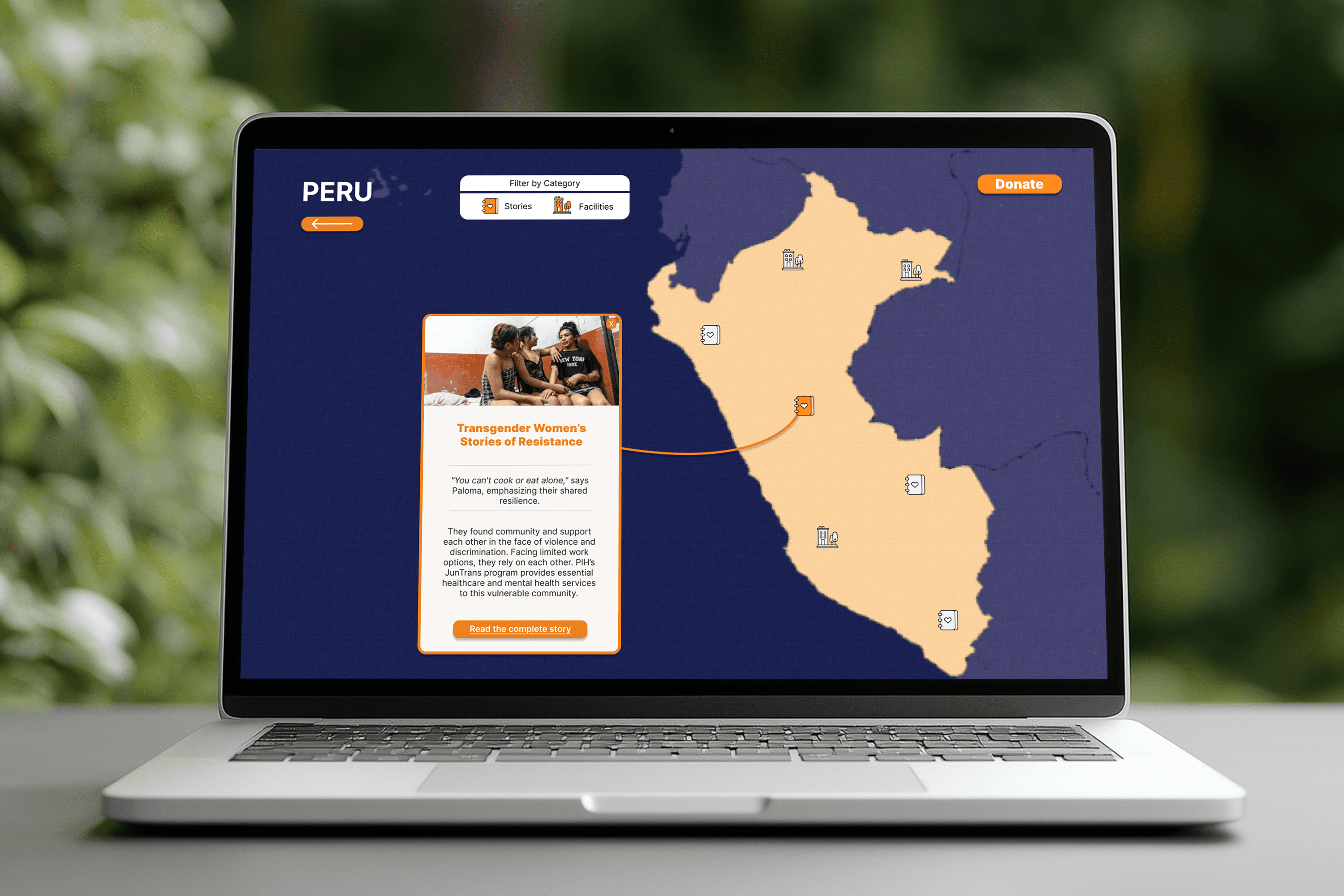
Story-driven interaction informed by donor feedback, prioritizing success stories, real patient narratives, and short videos over text-heavy reporting.
Categorized donation pathways to help users understand exactly where their money goes — healthcare, infrastructure, social support, essential resources, and more.
4. Three scalable prototypes that aligned different levels of PIH’s feasibility and technical resources.
User-Centric Design
Our design process strongly reflected user preferences gathered through surveys and interviews:
80% preferred visual proof of impact. PIH Final Idea Progress Report
89% wanted success stories and real-world statistics.
78% wanted simple, recognizable clickable points and hover summaries.
• 53% requested ways to filter impact by category. PIH Final Idea Progress Report
We embedded all these expectations into the final concept. The donor journey was refined into four clear touchpoints: exploring → filtering → learning → donating.
Detailed Pages and Features
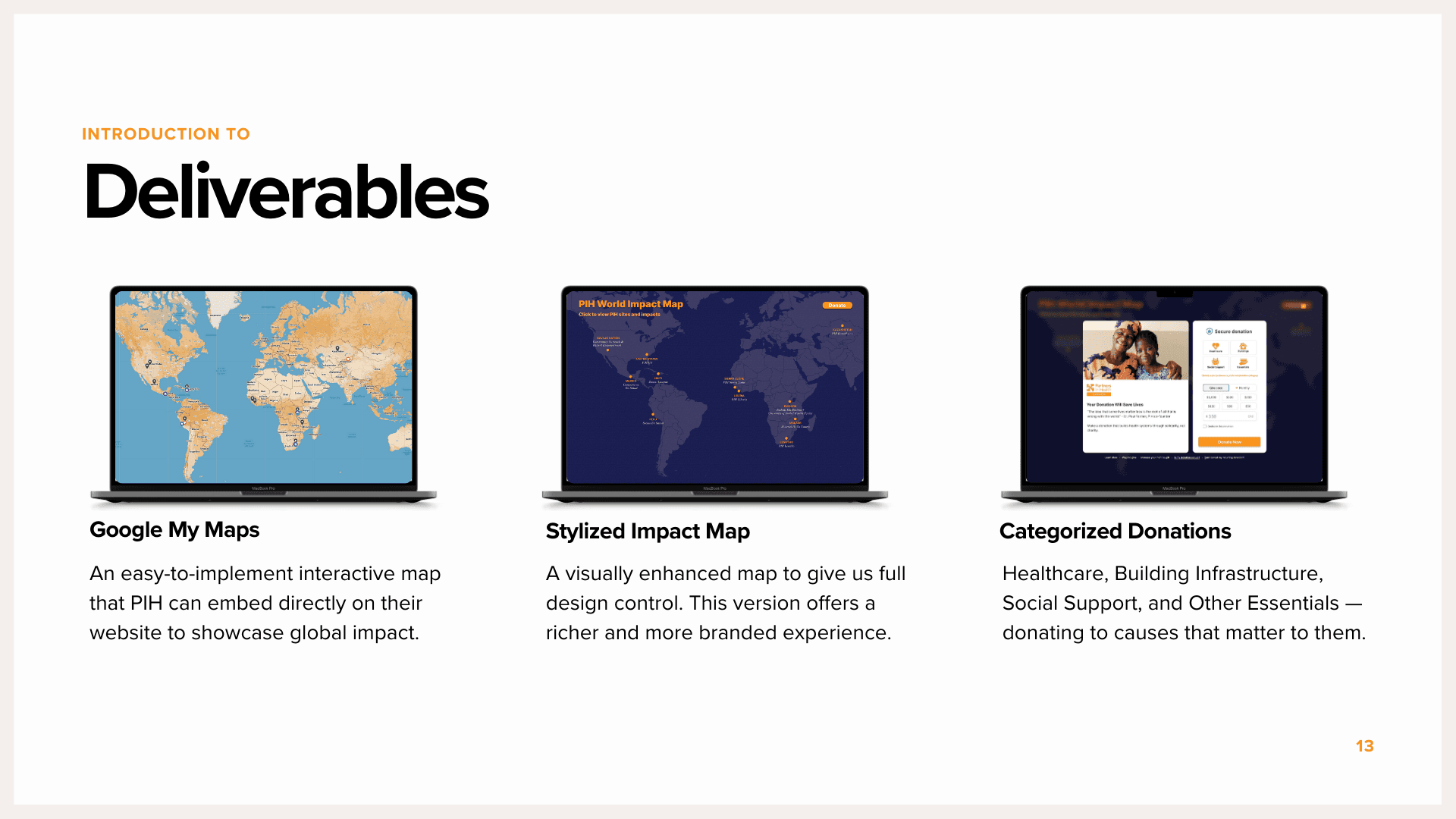
Our final prototype delivered three levels of interactive application, each supported by research and aligned with PIH’s needs:
1. Google My Maps Prototype A lightweight, quick-to-implement solution that PIH could embed immediately.
Connected to Google Sheets for easy content updates
Clickable markers linked to stories, data, and regional information
Created for smooth adoption with minimal technical barriers
2. Stylized Impact Map A richer, brand-aligned experience with:
Custom visuals, branded UI elements, and expanded storytelling
Video-based impact moments to strengthen emotional engagement
Scalable layout for future interactive features
3. Categorized Donations Prototype A redesigned donation flow that groups PIH’s work into clear thematic categories such as:
Healthcare
Building Infrastructure
Social Support
Education & Essentials
This structure improved transparency and ensured donors understood exactly what they were contributing to.
Accessibility and Optimization
We intentionally designed the experience to be accessible and functional across devices and connection speeds. Research considerations included:
adaptive scaling for mobile
larger tap-friendly interaction points
simplified pop-ups for readability
low-bandwidth versions for slower regions
quarterly or automated updates via Sheets or eventual CRM integration
These steps made the prototype not only user-friendly but realistic for PIH to maintain.
Conclusion
The Interactive Impact Map reimagines PIH Canada’s donation experience by making transparency tangible and impact immediate. rooted in research, built around storytelling, and optimized for accessibility, the project transforms complex global health operations into an intuitive, emotionally compelling journey that fosters trust and recurring support.
Contributing Creatives
Natasha Martin, Emma Smith, Chloe Chu